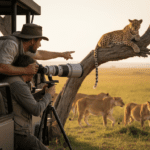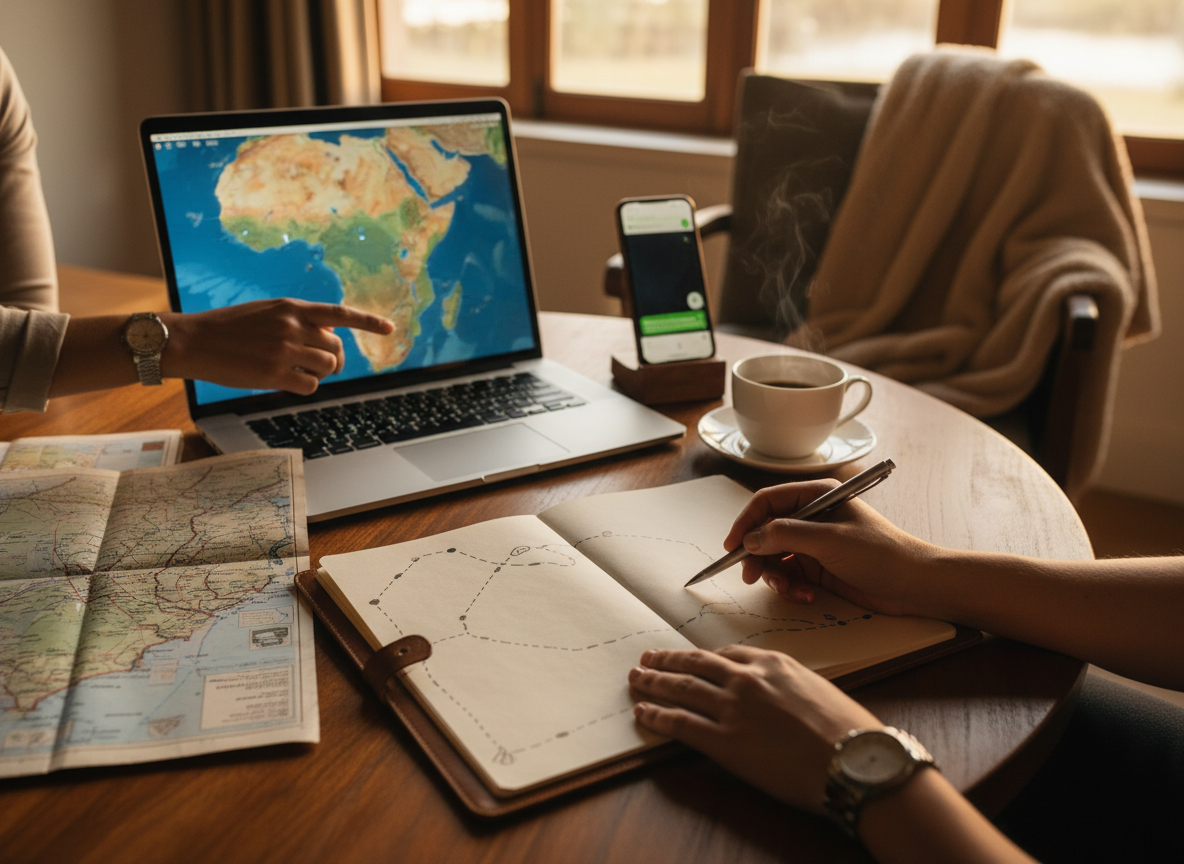
These two approaches to booking a Kenya safari look similar from the outside but produce quite different results. The camps you stay in, the game-drive schedule you follow, the pace across the trip — all of these shift substantially depending on whether you start from a published package or design the itinerary yourself.
The right choice depends on your flexibility, your specific preferences, your group composition, and how much of the planning work you want an operator to absorb on your behalf. Here is a clear comparison of both formats to help you decide.
What Is a Safari Package Deal?
A Kenya safari package deal is a pre-designed itinerary that an operator publishes with fixed content:
- Specific departure dates
- Fixed accommodation at one, two, or three named camps
- Set number of nights at each location
- Included activities (typically two or three game drives per day)
- Set meal plan (usually full board)
- Ground transfers or bush flights as specified
- Published per-person price based on double occupancy
Package deals are designed to be bookable with minimal back-and-forth. The operator has pre-negotiated rates with specific camps, set the departure schedule, and created a product that works for a broad range of travelers with similar interests and available dates.
What Is a Build-Your-Own (Bespoke) Safari?
A bespoke Kenya safari means working with an operator to design the trip from the starting point of your own requirements rather than from a pre-built template:
- Your choice of travel dates
- Your choice of camps across any combination of parks
- Duration at each location determined by your priorities
- Activities added, removed, or modified based on specific interests
- Budget allocation guided by what matters most to you
- Single travelers, couples, families, and groups all accommodated with appropriate configurations
- Domestic flights, transfers, and ancillary bookings coordinated as part of the package
A bespoke safari is not necessarily more expensive than a comparable package deal. It is simply designed around specific requirements rather than assumed ones.
Key Differences
| Factor | Package Deal | Build-Your-Own (Bespoke) |
|---|---|---|
| Departure dates | Fixed options | Your choice |
| Accommodation | Pre-selected, fixed | Any camp you choose |
| Itinerary flexibility | None once booked | Full, through direct conversation |
| Group composition | Shared (unless you buy private) | Private by default |
| Customization | Minimal | Complete |
| Pricing | Fixed per-person rate | Quoted to your specifications |
| Booking process | Simple: select and pay | Requires a consultation |
| Best value scenario | Solo travelers joining shared groups; simple itineraries | Families; groups of 4+; exclusive camp preferences |
| Operator expertise required | Low | Medium (the operator guides the design) |
When Package Deals Work Best
A Kenya safari package deal is the logical choice in specific situations:
You are a solo traveler joining a group departure. Shared group packages distribute vehicle and guide costs across multiple passengers, significantly lowering the per-person cost. A solo traveler joining a group vehicle avoids the single supplement that applies on any private arrangement. For solo budget-conscious travelers, this can be the most economical path to the Masai Mara.
You do not have specific camp preferences. If you have not yet researched the difference between camps in the main reserve and conservancy-based properties, a well-designed package simplifies decision-making. A reputable operator will have selected camps appropriate for the experience level and budget of their typical package guests.
The fixed itinerary fits your travel window. If the package covers your preferred dates and includes the parks you want to visit, there is no reason to go through the customization process when the pre-built product already matches your requirements.
You want a simple booking experience. Choose a departure date, pay a deposit, receive a confirmation. No consultation required. For travelers who prefer clarity and speed over optimization, this is a genuine advantage.
When Build-Your-Own Works Best
A bespoke safari design is clearly superior in a range of situations:
You have specific camp preferences. If you have researched Angama Mara, Cottar’s 1920s Camp, Mara Plains, or other exclusive properties and want to stay at one of them, package deals rarely include the most sought-after camps. Those properties manage their occupancy directly and their rates are not built into group packages. Direct bespoke arrangements are the standard approach.
Your dates are not aligned with published departure schedules. Package departures are typically fixed to weekends or specific days of the week. If your travel window falls outside those schedules, a bespoke arrangement gives you full date flexibility.
You are traveling as a family with children. A bespoke design allows you to select camps with appropriate minimum age policies, configure interconnecting rooms or family tents, pace game drives for children’s energy levels, and communicate dietary and health requirements ahead of time. Package deals are not designed around family logistics.
You want a multi-park Kenya circuit. Masai Mara plus Amboseli plus Samburu plus the Kenya coast in a specific sequence and duration: package deals typically cover one or two parks. A full Kenya circuit requires bespoke design, because the routing, timing, and accommodation selection across four or five destinations cannot be standardized.
Your group is large. Eight to twelve friends or family members traveling together almost always get better value from a bespoke group arrangement than from trying to book multiple spaces on a fixed package. The economies of a private vehicle for a large group, combined with accommodation rates negotiated for the group size, typically produce more competitive per-person pricing than packages designed for two.
The Cost Question
Package deals are not automatically cheaper than bespoke safaris. The relationship between price and format is more nuanced than that.
Where packages are typically cheaper:
- Solo travelers joining shared group vehicles (the vehicle cost is distributed across more people)
- Couples on standard mid-range itineraries at popular camps where group rates apply
Where bespoke itineraries match or beat package pricing:
- Groups of four to six in a private vehicle (per-person vehicle costs become competitive with shared packages)
- Travelers with specific camp preferences (direct operator relationships often yield better rates than platform-distributed packages)
- Long itineraries where an operator can optimize across multiple components — accommodation, transfers, activities — in ways that pre-built packages cannot
The honest answer is that cost comparison between a package and a bespoke alternative requires looking at the same parks, same camps, same inclusions, and same dates. On that basis, the gap is often smaller than expected.
A Practical Framework for Deciding
Work through these questions in order:
- Do you have specific departure dates fixed? If yes and they match a package departure, start there. If your dates are flexible or non-standard, bespoke is likely necessary.
- Do you have specific camp preferences? If you have researched particular camps and want those specifically, bespoke is the route. If you are comfortable with an operator selecting appropriate camps for your budget and interests, a well-designed package can work.
- What is your group composition? Solo traveler joining a group departure, or a couple on a straightforward itinerary: package. Family, large group, non-standard logistics: bespoke.
- How many parks do you want to visit? One or two parks: packages exist for this. Three or more parks in a custom sequence: bespoke design is necessary.
- How much planning engagement do you want? Package: minimal. Bespoke: a substantive conversation with the operator about what you want.
What the Operator Consultation Process Looks Like
For travelers new to the bespoke route, the process is less complicated than it sounds. A good Kenya operator starts with a few questions: your travel dates, the number of people, which parks you want to visit, your approximate budget, and any specific requirements (dietary, mobility, photography focus, honeymoon, conservation interest).
From those inputs, the operator produces a draft itinerary with specific camp recommendations, a cost breakdown including all inclusions, and an explanation of why the camps and routing were chosen. You review, ask questions, adjust. The itinerary evolves through two or three exchanges until it matches what you want. The total time from first contact to confirmed booking is typically a few days for a straightforward trip, a week or two for complex multi-park circuits.
What to Read Next
- How to evaluate a Kenya safari operator before you book
- Online booking vs booking direct with an operator: which produces better results
- Masai Mara conservancy camps vs main reserve: the key differences
Take the time to match the format to your specific requirements. The format decision is the first filter — the camp and itinerary decisions follow from it.
Turn this reading into a real itinerary with help from a Kenya-based safari team.
Start Planning Your Safari